Tuesday, November 11, 2008

Gender in Japan


Gender in Japan is different, to be sure. On a daily basis I am shocked at how many boys tend dress rather on the effeminate side, with outrageous hair-dews and sometimes even make-up. Even on campus at Kansai Gaidai I am surprised to see girls who dress more boyishly (I use the word 'surprised' as girls fashion here tends to be quite 'girly'; that is, lots of bows, short skirts and shorts and high heels galore.) As I have mentioned in previous posts, fashion here is raging, and so it is not surprising that the fine line between the male and female gender is often toyed with and crossed. This particular blog consists all of photographs that were taken during the gay pride parade in Osaka on October 18th. I thought these photographs would be perfect when discussing gender in Japan because this particular event proved to me that even though times are changing and people are becoming more open to the idea of the reversal of gender roles, there still seems to be a great deal of hostility towards the subject. For example, as I was walking in the parade, I came upon an old man who was standing in the middle of the crowd grabbing people, yelling at them in Japanese and shaking them. Although I couldn't make out exactly what he was saying, it was obviously not good. Although the people around me just laughed off the situation, it made a lasting impression on me because it really proved that in terms of gender identity, we are in a big period of transition- not only in Japan, but across the world.
 

I would also like to add at this point that I did not purposefully use only pictures of men cross-dressing and pushing the boundaries of their of gender; indeed, this is an important half of the equation. However, I found almost no women who were cross-dressing as men or even standing out in the crowd at all.  I was very surprised by this, and also a little puzzled. I have heard that it is simply not as accepted here for a woman to be lesbians or bi-sexual, but I didn't really believe it until I went to the gay pride parade. Although I do see some girls on the campus who dress more boyishly (with baggy jeans, timberland boots and jerseys), I felt that perhaps this was more of a fashion statement rather than an attempt at pushing the the boundaries of gender. Nevertheless, the word about homosexuals (yes, even lesbians) is definitely on rise.

Here is a link to a short article written about Mizuho Fukushima, a lesbian Japanese political leader:


Sports in Japan

I decided to do this post on sumo wrestling, since this sport originated in Japan, and Japan is also the only country where it is practiced professionally. After doing some research into the topic, I discovered that these mens lives are actually highly regimented and they are required to follow strict rules and guidelines that are put in place by the Sumo Association- I was totally unaware of this previously. This is mostly due to the fact the tradition of sumo wrestling is ancient, and also because there are some ritual aspects to the sport which come from the Shinto religion, the national 'religion' of Japan. Therefore, because of these important associations in Japanese culture, it is important that respect for this sport be upheld to the highest degree. These particular pictures were taken from a sumo event which happened in Tokyo at the Ryogoku Kokugikan.  
 
It is almost comical to me the amount of time that is spent announcing the fights, introducing the fighters and even the dance of the Yokozuna, or the highest position held on the official listing of rank (these people are often referred to as living symbols of sumo). When it becomes ready for the fight, it is all over in an instant, and so much of the time is spent merely watching the motions that are gone through for every fight, every time. This is much different from any sports in the United States (and elsewhere for that matter), specifically I am thinking of basketball or soccer, in which almost the ENTIRE time of the game is spent in action.  But then again, that the fact that the Shinto tradition/ancient tradition is what makes this sport so interesting and unlike any other sport in the world. 

**If you would like to learn more about the traditions and rules of sumo wrestling, check out this website: 

Globalization in Japan

For this post I decided to take up the issue of coffee/coffee shops in Japan. Although I am aware that there are many other (possibly more interesting) forms of globalization at work in Japan, I am particularly drawn to coffee shops and fast food restaurants. The first picture was taken on the very first day that I came to the Kansai Gaidai campus. I was SO surprised to find a Seattle's Best Coffee in Japan, let alone on campus! I was particularly excited because I worked a part time job at Seattle's Best the summer right before I came to Japan, so everything about the job was still fresh in my mind. When I came here, I was thinking "Great, I finally get to leave everything that I know behind and experience something completely new...." 
Low and behold, somethings didn't change a bit. In fact, I went inside the Seattle's Best on campus expecting to maybe find some variation in the menu at least, but no. It was exactly the same as what I had been selling just a couple of weeks before. The only difference I could see was in the point card that they give out for free, and it was only different because it was written in Japanese. I was pretty disappointed. 
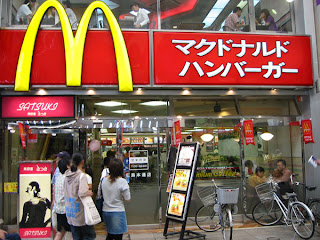
Furthermore, the fact that there is a McDonald's RIGHT next door to Seattle's Best (this particular picture was taken in Tokyo) didn't make me feel much better. In fact, I remember feeling a bit sick to my stomach to think that greasy, unhealthy American fast-food had managed to slither into Japanese society with no problem. And I won't even begin to talk about Starbucks, mostly because everyone knows that Starbucks is (like McDonald's) a multi-national corporation with stores all over the world. Therefore, it's not surprising to see these two particular companies thriving in a developed country like Japan. Still, something feels wrong to me about this situation... so totally wrong. It is not only that I am vegetarian and so DESPISE places like McDonald's (McDeath as I like to call it), but also because this phenomenon says something about the scale of the world markets and the necessity of countries that slightly behind the United States in terms of GDP to import and adopt things like McDonald's and Starbucks. 

At least the portions at McDonald's are not as out of control as they are in the United States, and even the menus are different. Thats about the only positive thing I can say about this situation; the Japanese can get their fill of greasy food, but maybe postpone the on-set of diabetes just a little...       


Traditional Japanese Culture

In my opinion, one of the best expressions of real traditional Japanese culture are the festivals. Every year there are thousands of festivals that take place in different locations all across Japan, and all for different purposes. This particular picture was taken at the Fushimi-inari Taisha shrine (a popular location for Shinto worship) in Kyoto during the annual fire festival. Because this is the largest Shinto shrine in all of Japan, many festivals take place here and most of them have to do with the worship of some aspect of nature (such as rice harvesting or moon viewing). What is particularly amazing about this shrine is the large number of red torii gates which line the paths running behind the buildings. The word 'Inari' signifies that this particular temple is sacred to a deity named Ukano Mitama no Okami; the divinity of Fushimi-Inari Shrine is said to bring prosperous business and large harvests. Therefore, many people visit this shrine every year to pay their tributes.
    
These two photographs represent some of the traditional aspects of Japanese culture that will undoubtably be found at any festival you visit in Japan. In this case, the first picture shows some of the items that are thrown into the fires at the fire festival: rice, salt and leaves from the surrounding area. These items are used because they represent purity (as both salt and rice are white in color, which match the ceremonial garbs worn by the Shinto priests. The second photo shows some Japanese women singing some traditional Japanese songs while being accompanied by the beautiful sound of the Koto- a traditional Japanese instrument which was derived from the Chinese zither.  It is the national instrument of Japan and so has obviously played a large part in traditional Japanese culture.

So, if you want to experience some really good traditional Japanese culture, visit any festival and you are sure to find something new and exciting.

**If you want to learn more about Shinto in Japan, check out this informative website:

Sunday, October 19, 2008

Japanese Pop Culture...

IT'S EVERYWHERE! For such a small island, it really is amazing to me just how many shopping malls you can find in such close vicinity to each other, all selling the most popular clothes, music and accessories. Instead of being spread across the land (like in the United States for example), these shopping malls rise vertically towards the sky, each floor packed on top of the next, full of the latest goods to be sold. This particular photograph was taken recently in one of the MANY shopping centers in Shibuya, Tokyo, which, being one of the most notorious areas in Japan for great shopping, is always packed full with eager shoppers searching for the perfect bag or pair of shoes to match their new outfits. 


Of course, because there is such a huge emphasis on consumerism here in Japan, there is also great attention paid to the quality of customer service (as I mentioned before in my post 'Neighborhood Hirakata'). I decided to post this picture (also taken during my trip to Tokyo) because I think it really captures the eagerness of the Japanese to help customers as they shop for whatever product they are interested in, whether it be electronics or fancy clothes.  

And so, consumerism in Japan continues to run WILD, and it really does seem as though there is nothing that you simply can't buy. This trend in consumerism is, of course, responsible for allowing Japan to quickly develop from an agrarian society into a world super-power, almost overnight. This topic, for me, is one of the most interesting ones to consider when thinking about the Japanese nation as a whole, so if you are also interested in the development of Japan into a major competitor in the world market, you should check out this link:

(Go to the 'Title' search bar and enter: 'Japanese Popular Culture in East and Southeast Asia')

**AND for your viewing pleasure, a video taken from THE most popular intersection in Japan, right outside of the Shinkansen Tokyo terminal. This is for all of you who have not yet made it to Tokyo, so that you can see the size of the consumer crowds in this particular location... 


Wednesday, October 1, 2008

Japanese People

Japanese people....aah, what a broad topic to write about. I could say so much about my impressions of Japanese people, but I decided to start with this photograph of Japanese women cleaning the streets. They were sweeping up leaves and collecting them in bags as other people were pruning the gardens which surround this area. I included this photo, which I took recently when I visited Osaka castle because ever since the first time I came to Japan, I noticed how incredibly CLEAN things are here.  Coming from the 4th largest city in the United States, I am quite used to seeing clutter and mess around the city. In all honesty, I was blown away by how clean the subway stations are here and the streets in general. In fact, the first time I came to Japan I was in a station in Nagoya and saw an old man meticulously cleaning the stairs with a hand-held vacuum cleaner which was strapped to his back. I was totally in awe because the stairs weren't even dirty!  I simply couldn't believe the dedication to cleanliness here. In all honesty, this was one of the reasons I decided to return to Japan. I am not saying that this is always the case; in fact, recently when I was in Tokyo I discovered an area in Shinjuku station in which the floors were almost completely covered with homeless people and trash. This was quite shocking to me as it was in stark contrast to what I have seen elsewhere. Still, in general I am impressed by the drive that the Japanese people have to keep their city streets clean and orderly. No doubt this is a necessity when living in such a compact area. 


On the same trip to Osaka castle, we encountered this guy; an interesting character indeed....
I decided to include this photo because I feel like this proves another point about Japanese people that I have thought since the first time I came here (and even before that really): Japanese people are UNIQUE. I think from a Western point of view, we tend to sometimes think that because the island of Japan is relatively small and was for a long time cut off from the rest of the world, that somehow they (Japanese people) all have the same basic characteristics because they have such tight-knit communities. However, this is actually couldn't be farther from the truth; everyday that I go out to visit some interesting new place, I am always taking note of the variations of people, like this man for example. In front of him him was three cans, each for a different amount of money. Depending on which can you put money into, he would play a song and the songs got more complex the higher the amount of money you deposit. After the song was finished, he would return to a frozen posture, waiting for the next person to deposit money.
I've decided that there is really no way to categorize Japanese people other than their nationality, and to do so would be missing something. Beyond nationality, it is really open ended as to how each person will choose to express themselves, and you can never be sure of what you will encounter next.  But, of course, this should not come as any big surprise, since in reality this holds true for all places on planet earth. Of course 'Japanese people' do have some common qualities, but with these commonalities also comes great diversity.         

** At Osaka castle I took a video of this man who was entertaining the crowds with his unique skill....check it out. **


Exploring Hirakata--->

This picture was taken in early September on my very first outing around Hirakata. After knowing the people in the picture (I will leave them anonymous just in case...) for only 5 minutes or so, we left the seminar house together and rode off in search of an electronics store.  Because we were short one bike, we decided to follow the example of the Japanese kids around Hirakata, whom we had seen several times before skillfully maneuvering through the streets carrying their friends on the backs of bicycles. How easy they make it look! I suppose our thought process was, "If they can do it, surely we can too!" In reality, it is quite a difficult task and we stopped more than a couple of times due to near accidents. As the driver finally got the hang of it though, we began to cruise the streets until we realized we were totally lost.  After using what LITTLE Japanese we knew at the time to ask directions from local pedestrians, we were able to eventually find our way to K's electronics, where we again made use of our elementary Japanese in order to find an adaptor. The employees at K's were extremely helpful (albeit slightly amused, no doubt) and they even double checked with the supervisor to be certain that they had recommended the right product. If there is one thing that I have constantly noticed since arriving to Japan, it is the eagerness of employees to help customers. The kindness of the Japanese people was exhibited even in this very first trip around Hirakata.


To continue with the story, on the very same outing around Hirakata I also discovered KAPPA SUSHI, just around the corner from K's electronics.  I decided to post this picture because this type of restaurant is particularly intriguing to me, not just for the obvious reason (sushi on conveyor belts!?) but also because of the recent discussion in class about 100 yen shops and discount stores, which have apparently only recently popped up in Japan.  Prior to this phenomenon, people were quite secretive if they shopped at discount stores, almost as if they were ashamed. However, today so much has changed in Japan; this restaurant, for example, obviously does not serve the highest quality sushi, but you get a lot for your money. Every time I have been to Kappa Sushi, there is always a lot of business (the same with 100 yen shops for that matter) and for me this really drives home the point that (as we saw in the documentary Tokyology) Japan is indeed a place of constant growth and transition; never stagnant.      
                       
**For fun, I uploaded this short video that I took from the first time I visited Kappa Sushi....enjoy!